
The filmmaking industry is on the cusp of a revolutionary change. Virtual Production is no longer a futuristic concept; it's rapidly transforming how movies and television shows are made, offering unprecedented creative control, cost savings, and efficiency. But is the industry ready for this leap?
Foundational Context: Market & Trends
The global virtual production market is experiencing exponential growth. A recent report by Grand View Research estimates the market was valued at USD 1.54 billion in 2023, and is expected to grow at a compound annual growth rate (CAGR) of 18.5% from 2024 to 2030. This surge is fueled by several factors, including:
- Cost Reduction: Virtual production often reduces on-location shooting, leading to significant savings on travel, accommodation, and crew expenses.
- Creative Freedom: Filmmakers gain greater control over the environment and the ability to visualize complex scenes more effectively.
- Efficiency: Virtual production streamlines the post-production process by allowing real-time compositing and immediate feedback.
| Feature | Traditional Filmmaking | Virtual Production |
|---|---|---|
| Location Scouting | Extensive | Minimal |
| Set Construction | Physical | Virtual |
| Visual Effects | Post-Production | Real-Time |
| Cost | High | Potentially Lower |
| Creative Control | Limited | Greater |
Core Mechanisms & Driving Factors
At its core, virtual production combines several key technologies:
- Real-Time Game Engines: Software like Unreal Engine and Unity are used to create photorealistic virtual environments.
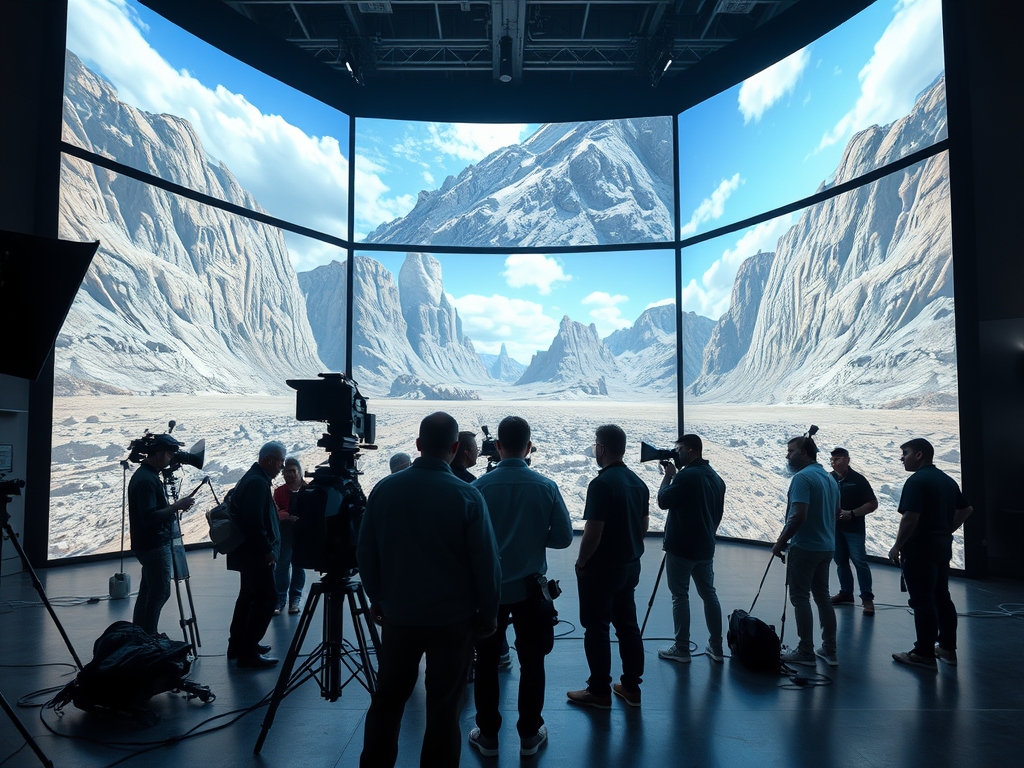
- LED Walls and Ceilings: These displays project the virtual environment onto the set, providing the background for actors and physical props.
- Camera Tracking: Sophisticated tracking systems monitor the camera's position and orientation, allowing the virtual environment to move in sync.
- Motion Capture: Actors' movements can be captured and translated to digital characters or used to animate elements within the virtual environment.
These components work in tandem to create a seamless blend of physical and digital elements.
The Actionable Framework: Getting Started with Virtual Production
Transitioning to virtual production can seem daunting. Here’s a simplified workflow:
Step 1: Planning and Pre-Visualization
This stage is crucial. Storyboarding, pre-visualization, and determining the scope of virtual production elements are essential.
Step 2: Virtual Environment Creation
This involves building the digital assets, environments, and elements within a game engine. Detailed planning is required.
Step 3: Set Design and Integration
The physical set is built, and LED walls and tracking systems are implemented to match the virtual environment.
Step 4: Production and Performance Capture
Actors perform in front of the LED walls, interacting with the virtual environment in real-time. Camera movement and lighting are synced with the digital world.
Step 5: Post-Production Refinement
Minor adjustments, compositing, and final touches are applied during post-production to refine the visuals.
Analytical Deep Dive
Consider the success of The Mandalorian. Its innovative use of virtual production, particularly the "Volume" – a large LED wall environment – significantly reduced location shooting, saved costs, and enhanced the visual storytelling. This method enabled creators to quickly adjust environments and lighting to match actors’ needs and creative visions.
Strategic Alternatives & Adaptations
For Beginner Implementation, start with smaller projects. Experiment with virtual backdrops or integrating CG elements into existing productions. For Intermediate Optimization, invest in advanced camera tracking systems and explore more complex virtual environments.
Expert Scaling can involve establishing a full virtual production pipeline with dedicated studio space and a skilled team.
Validated Case Studies & Real-World Application
The upcoming film Avatar 3 is heavily relying on virtual production. This strategy not only creates visually stunning scenes but also ensures a cohesive aesthetic across the film.
Risk Mitigation: Common Errors
A major pitfall is underestimating the complexity. Ensure that your team has adequate training and experience with the software and hardware. Furthermore, not properly budgeting or accounting for the time required to set up the virtual environments can hinder a project's productivity.
Performance Optimization & Best Practices
- Invest in High-Quality LED Walls: These are the backbone of virtual production, and quality impacts the final look.
- Prioritize Camera Tracking Accuracy: Precise camera tracking ensures the seamless integration of the virtual environment.
- Optimize Asset Creation: Optimize virtual assets for real-time rendering.
- Embrace Collaboration: The success of virtual production relies on collaboration across departments, including visual effects, cinematography, and production design.
Scalability & Longevity Strategy
To maintain long-term success, continuous learning and adaptation are crucial. Staying updated on the latest software updates and hardware advancements is vital. The potential to scale involves not just equipment but also the development of a trained and highly skilled workforce specializing in all aspects of virtual production.
Knowledge Enhancement FAQs
Q: What are the main advantages of using game engines like Unreal Engine in virtual production?
A: Game engines offer real-time rendering capabilities, allowing filmmakers to see the final look of a scene during shooting, facilitating instant feedback and iteration.
Q: How does the "Volume" or LED wall setup work in virtual production?
A: The Volume is an LED screen, often curved, used as a backdrop to create a virtual environment. Camera tracking data moves the background to correspond to the camera's position, making it look real.
Q: What are the primary cost savings that virtual production offers compared to traditional filmmaking?
A: Significant savings come from reducing or eliminating the need for expensive location shoots, building physical sets, and mitigating post-production VFX complexities.
Q: What skills are most in demand in the virtual production industry?
A: Expertise in game engine software (Unreal Engine or Unity), virtual art creation, LED panel operations, camera tracking systems, and a solid grasp of filmmaking principles.
Conclusion
The evolution of virtual production in filmmaking is more than just a technological shift; it's a fundamental change in the creative process. It empowers filmmakers with unprecedented control, enhances production efficiency, and opens new creative doors. Embrace this transformative technology and revolutionize your filmmaking approach today!
Ready to start? Investigate our recommended AI tools for content generation and video creation, and explore our other digital strategy resources.