
Did you know that by 2028, the virtual production market is projected to reach a staggering $5.3 billion? This rapid expansion is a testament to the transformative power of virtual production in filmmaking, shaking up the traditional Hollywood model and opening doors to unprecedented creative possibilities. In this article, we'll dive deep into the world of virtual production, exploring its capabilities, challenges, and the potential it holds for the future of cinema.
Foundational Context: Market & Trends
The film industry is constantly evolving, but the rise of virtual production represents a seismic shift. Traditional filmmaking often involves shooting on location or using physical sets, followed by extensive post-production work to add visual effects. Virtual production streamlines this process by bringing much of the post-production into pre-production and the shooting phase.
Key Market Trends:
- Cost Reduction: Virtual production can significantly reduce production costs by minimizing the need for location shoots and physical set construction.
- Creative Control: Filmmakers gain greater control over the environment and visual effects, allowing for more creative freedom.
- Faster Turnaround Times: The integrated workflow speeds up the production process, enabling faster turnaround times for projects.
- Technological Advancements: The continuous development of real-time rendering engines, LED wall technology, and motion capture systems is driving further innovation.
Core Mechanisms & Driving Factors
The success of virtual production hinges on several key elements:
- Real-time Rendering Engines: Software such as Unreal Engine and Unity enable filmmakers to create realistic virtual environments that can be displayed on LED walls in real-time.
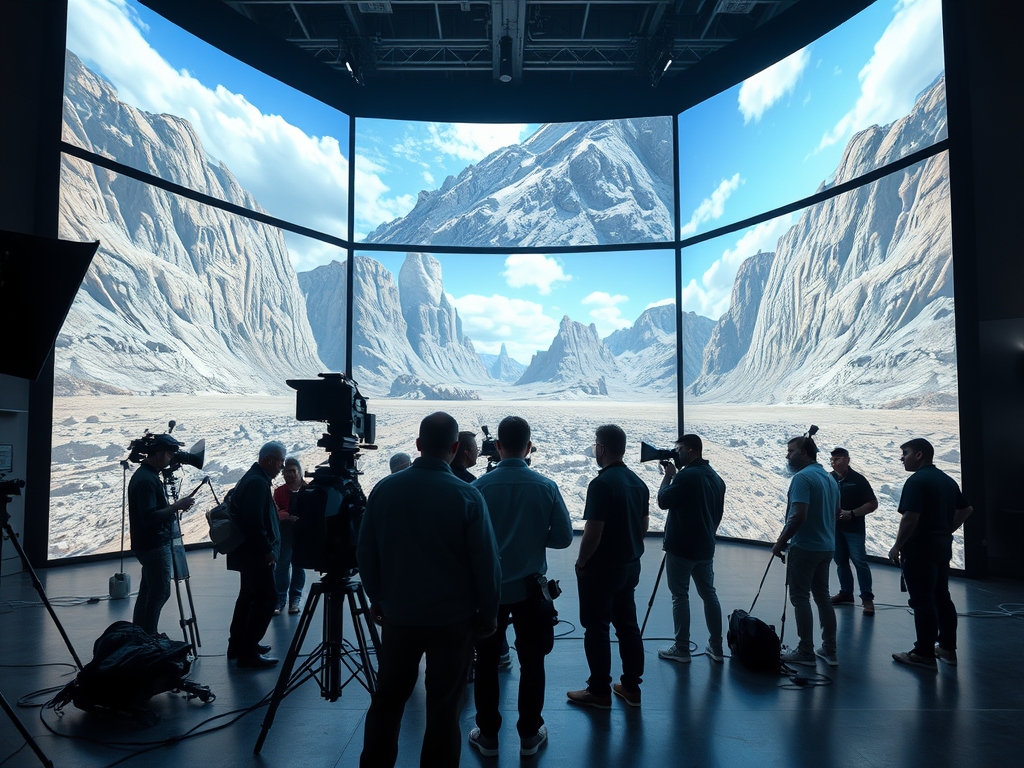
- LED Wall Technology: Large, high-resolution LED screens serve as the backdrop for actors and provide interactive lighting and environmental effects.
- Motion Capture: This technology captures the movements of actors and objects, allowing them to interact with the virtual environment seamlessly.
- Virtual Cameras: These allow filmmakers to visualize and compose shots within the virtual environment, providing real-time feedback.
- Collaboration: A multidisciplinary team of specialists including virtual production supervisors, Unreal Engine artists, visual effects artists, and cinematographers working in tandem.
The Actionable Framework: Implementing a Virtual Production Workflow
Step 1: Pre-Production Planning
- Define the Scope: Clearly outline the scope of the project and how virtual production will be used (e.g., creating a specific environment, enhancing visual effects).
- Storyboarding & Previsualization: Use storyboards and previsualization to plan shots and scenes and test how they translate into a virtual environment.
- Team Building: Assemble a dedicated team, including specialists in virtual production, visual effects, and real-time rendering.
Step 2: Virtual Environment Creation
- Asset Creation: Design and build the virtual environment using 3D modeling software and game engines.
- Lighting & Texturing: Optimize lighting and textures to achieve a high degree of realism.
- Integration & Testing: Integrate all assets and thoroughly test the virtual environment for functionality and performance.
Step 3: Production Phase
- Camera Tracking: Calibrate and track the movement of the physical camera to the virtual camera.
- Performance Capture: Capture the performances of actors using motion capture and other technologies.
- Live Compositing: Compositing the live action performance in the physical space to the digital environment on the LED walls.
Step 4: Post-Production
- Fine-Tuning: Make any necessary adjustments to the virtual environment or performance based on feedback from the production phase.
- Final Compositing: Integrate all the different elements to create the final polished scenes.
- Color Correction: Finalize the color grading and color correction
“The integration of real-time technology is transforming film production, and we're just scratching the surface of its potential," says Sarah Chen, a leading virtual production supervisor.
Analytical Deep Dive
According to recent studies, the integration of virtual production can reduce post-production time by up to 30%, leading to significant cost savings. Furthermore, production companies that adopt virtual production strategies typically see a 15-20% increase in creative control, which can lead to higher-quality outputs.
Comparison Table: Traditional vs. Virtual Production
| Feature | Traditional Production | Virtual Production |
|---|---|---|
| Pre-Production | Extensive location scouting, set design | Detailed previsualization, virtual environment creation |
| Production | Location shooting, physical sets, green screen | Studio shooting, real-time environment integration |
| Post-Production | Extensive visual effects, compositing | Reduced visual effects, real-time compositing |
| Cost | Higher, due to location, sets, and post-production | Potentially lower, due to efficiency gains |
| Creative Control | Limited to location, set design | Increased control over environment and visual effects |
Strategic Alternatives & Adaptations
- Beginner Implementation: Start with projects that integrate virtual elements such as a green screen workflow. This can act as a bridge into virtual production.
- Intermediate Optimization: Incorporate real-time compositing techniques to allow for greater flexibility on set.
- Expert Scaling: Invest in larger studio space, and advanced technologies to create fully immersive virtual production environments.
Validated Case Studies & Real-World Application
The Mandalorian, for example, is a prime example of the effectiveness of virtual production. By using large LED screens displaying virtual environments, the production team created immersive environments without the need for extensive location shoots. This approach streamlined the production and saved significant resources. Additionally, smaller productions have employed virtual production, allowing them to compete with larger studios.
Risk Mitigation: Common Errors
- Inadequate Planning: Insufficient pre-production planning can lead to workflow inefficiencies and increased costs.
- Technical Issues: A reliance on real-time rendering can result in unexpected technical glitches that are difficult to correct in real-time.
- Skill Gaps: A lack of necessary skill sets in virtual production can severely limit project potential. To fix these issues, ensure adequate training for personnel.
Performance Optimization & Best Practices
To maximize the benefits of virtual production, consider these optimization strategies:
- Invest in high-quality hardware: This includes robust computers, high-resolution LED walls, and advanced camera tracking systems.
- Optimize your virtual environment: Optimize the scenes for your virtual environments so they run fast enough during filming.
- Embrace iteration: Build in time for iteration and adjustments to ensure the final product meets expectations.
- Foster Collaboration: Successful virtual production relies on close collaboration between various departments, including the art, technology, and production.
- Stay updated: Virtual production is a rapidly evolving field, so continuous training and research are critical.
Scalability & Longevity Strategy
To ensure long-term success with virtual production, focus on these strategies:
- Continuous Learning: Continuously invest in training and skill development.
- Stay Current with Technology: Regularly update hardware and software.
- Seek Strategic Partnerships: Collaborate with tech vendors and other industry players.
- Focus on Innovation: Develop proprietary tools and processes for competitive advantage.
Conclusion
The adoption of virtual production in filmmaking is transforming the industry, offering cost savings, creative control, and faster turnaround times. By understanding its core mechanisms, implementing an effective framework, and mitigating potential risks, filmmakers can unlock a world of creative possibilities. The future of cinema is not just about telling stories, but crafting immersive experiences. The move towards virtual production is a critical step in that direction.
Knowledge Enhancement FAQs
Q: What is the main benefit of virtual production?
A: The main benefit is the ability to create complex visual effects and environment on-set, significantly streamlining the filmmaking process and offering greater control and creative freedom.
Q: What are the main tools used in virtual production?
A: Real-time rendering engines like Unreal Engine, LED walls, motion capture systems, and virtual cameras are some of the main tools.
Q: Is virtual production expensive?
A: While the initial investment in equipment can be substantial, virtual production can often lead to reduced costs in the long run.
Q: What skills are needed for virtual production?
A: Expertise in real-time rendering, 3D modeling, cinematography, and production management is crucial for a successful virtual production workflow.
Q: What are some of the biggest challenges in virtual production?
A: Virtual production challenges include technical complexity, the need for new skill sets, and the cost of hardware.
Q: How is virtual production changing filmmaking?
A: Virtual production allows for greater creative control, more efficient production workflows, cost-saving, and faster production cycles, which ultimately enhance the storytelling capabilities of filmmakers.