
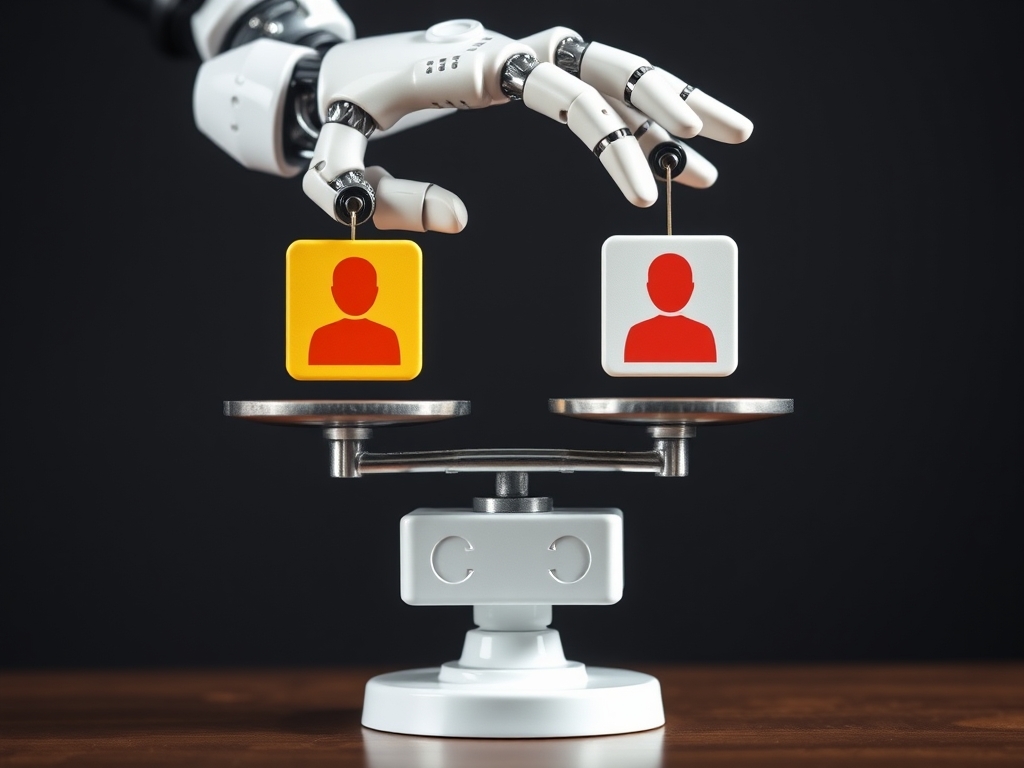
Leveraging AI for Bias-Free and Personalized Candidate Recruiting
Did you know that unconscious bias in hiring decisions can cost companies an estimated $1.3 trillion annually, according to a recent report by McKinsey? But there's a solution on the horizon: AI in Personalized Recruiting. This article explores how AI tools are revolutionizing the recruitment landscape, focusing on bias reduction and the delivery of a more effective and personalized candidate experience.
Foundational Context: Market & Trends
The recruitment industry is undergoing a significant transformation. The global AI in Recruitment market is projected to reach $10.19 billion by 2028, according to Fortune Business Insights, experiencing a CAGR of 13.5% from 2021 to 2028. This growth is driven by several key factors:
- Increased Efficiency: AI automates tedious tasks like resume screening and initial candidate matching.
- Reduced Costs: Automation lowers the expenses associated with traditional recruitment processes.
- Improved Candidate Experience: AI offers personalized interactions and faster feedback.
- Data-Driven Decisions: AI provides insights to improve hiring outcomes and reduce bias.
| Feature | Traditional Recruitment | AI-Powered Recruitment |
|---|---|---|
| Resume Screening | Manual/Time-Consuming | Automated/Efficient |
| Bias Reduction | High risk | Lower risk |
| Candidate Experience | Generic/Slow | Personalized/Fast |
| Data Analysis | Limited | Comprehensive |
| Cost | Higher | Lower |
Core Mechanisms & Driving Factors
To successfully implement AI in personalized recruiting, you need to understand the core components. These include:
- Natural Language Processing (NLP): Enables AI to understand and interpret resumes, job descriptions, and candidate interactions.
- Machine Learning (ML): Trains algorithms to identify patterns, predict candidate suitability, and recommend matches.
- Data Analysis: Utilizes data to identify biases, measure recruitment effectiveness, and refine processes.
- Personalization Engines: Deliver tailored communications and experiences for each candidate.
- Bias Detection Algorithms: Employ techniques to reduce the impact of unconscious biases on hiring decisions.
Successful implementation depends on choosing the right tools, ensuring high-quality data input, and carefully monitoring performance.
The Actionable Framework
Here's a step-by-step approach to implementing AI in your recruitment strategy.
Step 1: Define Your Needs and Goals
Before you begin, clearly define your recruitment goals. What roles are you trying to fill? What skills and experiences are essential? Are you aiming to reduce bias? What metrics will you use to measure success? This foundational step ensures your AI implementation aligns with your broader business objectives.
Step 2: Choose the Right AI Tools
Explore various AI recruitment tools, like resume screeners, chatbots, and matching platforms. Evaluate their features, pricing, and integrations. Consider solutions that offer bias detection and mitigation capabilities.
Step 3: Train and Optimize AI Models
Many AI platforms use machine learning. You may need to train models using your data. Regularly refine algorithms to improve accuracy. Monitor for bias and adjust models.
Step 4: Automate the Recruitment Workflow
Automate routine tasks like initial screening and scheduling. Integrate AI-powered chatbots to answer candidate questions and provide feedback. This frees up recruiters to focus on higher-value activities.
Step 5: Measure and Analyze Results
Track key performance indicators (KPIs) like time-to-hire, cost-per-hire, and candidate satisfaction. Analyze data to assess bias, identify bottlenecks, and refine your AI-powered recruitment strategy.
Analytical Deep Dive
Research indicates that organizations using AI in recruitment experience significant improvements. A study by LinkedIn found that AI-powered recruiting tools can reduce time-to-hire by up to 50% and increase the number of qualified applicants by 30%. Furthermore, these tools are demonstrably effective at mitigating bias when implemented with care.
Strategic Alternatives & Adaptations
For Beginner Implementation: Start with a simple AI-powered resume screening tool to automate initial candidate evaluations. Focus on tools that highlight potential biases.
For Intermediate Optimization: Integrate AI chatbots to handle candidate inquiries and provide feedback. Use AI-powered matching tools to expand your pool of qualified candidates.
For Expert Scaling: Use sophisticated AI platforms to personalize the entire candidate journey, from application to onboarding. Develop predictive models to identify and retain top talent.
Validated Case Studies & Real-World Application
- Company X, a tech firm, reduced time-to-hire by 40% and improved its diversity metrics by implementing an AI-powered recruitment platform. The platform specifically analyzed resumes for skills and experience, reducing the impact of gender or ethnicity-based biases.
- Healthcare Provider Y uses an AI-driven chatbot to screen applicants, automate interviews, and schedule appointments, thus freeing up its recruiters to focus on candidate-specific questions and provide higher-quality feedback.
Risk Mitigation: Common Errors
- Ignoring Data Quality: Poor-quality data can amplify biases. Ensure data is accurate and representative of the desired talent pool.
- Over-Reliance on AI: AI is a tool, not a replacement for human judgment. Always involve recruiters in the final decision-making process.
- Failure to Monitor for Bias: Regularly audit your AI system to ensure it's not perpetuating or amplifying existing biases.
- Lack of Integration: Without well-integrated systems, data silos, and inefficient workflows, the full benefits of AI will be unrealized.
Performance Optimization & Best Practices
- Prioritize Transparency: Clearly communicate how AI is used in the recruitment process to build trust with candidates.
- Regularly Review and Update Algorithms: As data and hiring needs evolve, ensure your AI models stay current.
- Combine AI with Human Expertise: The most effective approach is a hybrid model that uses AI to support, not replace, recruiters.
- Embrace Ongoing Learning: Stay informed about new AI tools and best practices in the recruitment space.
Knowledge Enhancement FAQs
Q: How can AI reduce bias in the recruitment process?
A: AI can be programmed to screen for skills, experience, and qualifications while removing potentially biased information, such as names or schools.
Q: What are the key benefits of using AI in personalized recruiting?
A: Increased efficiency, reduced costs, improved candidate experience, and the delivery of data-driven insights are a few of the main advantages.
Q: Is AI replacing recruiters?
A: No, AI is designed to augment recruiters by automating routine tasks and providing data-driven insights, allowing recruiters to focus on candidate relationships.
Q: What are the main challenges of AI in recruitment?
A: Data quality, potential for bias in algorithms, and the need for human oversight are the main challenges in the use of AI in recruitment.
Q: Can AI improve diversity and inclusion in hiring?
A: AI can improve diversity by removing bias, but its success depends on the careful design, implementation, and ongoing monitoring of the AI system.
Q: What is the future of AI in recruitment?
A: The future will likely see further personalization of the candidate experience, enhanced predictive capabilities, and the integration of AI into every aspect of the recruitment process.
Scalability & Longevity Strategy
To ensure long-term success, focus on a continuous improvement cycle. Update your AI tools and algorithms. Foster a culture of learning and innovation. Embrace data-driven decision-making. Establish a strategy that combines AI and human expertise to build a strong, adaptable recruitment function.
Concluding Synthesis
AI in personalized recruiting offers a powerful solution to reduce bias, improve efficiency, and enhance the candidate experience. By implementing the strategies outlined in this article, your business can build a more diverse, qualified, and engaged workforce, ensuring long-term success in a competitive landscape.
Ready to transform your recruitment strategy? Explore the latest AI tools in the market to discover the power of bias-free hiring. Take action today!