
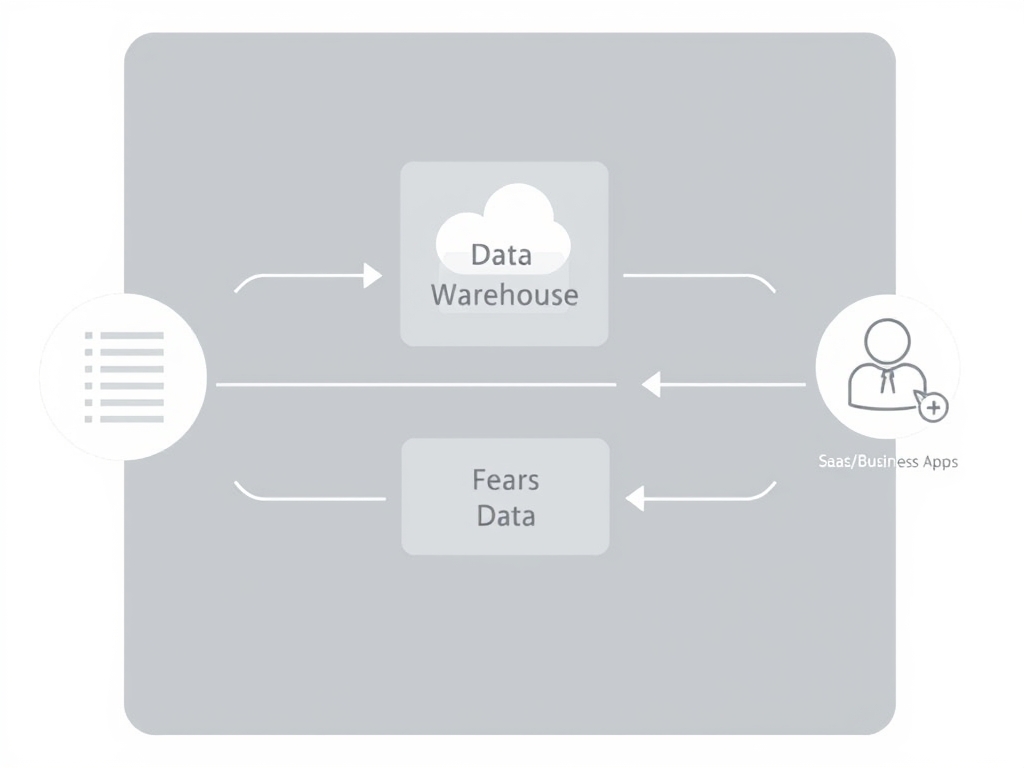
Did you know that companies lose an average of 10% of their revenue annually due to poor data utilization? This statistic highlights a critical gap in many organizations: the effective movement and application of data. This is where Reverse ETL steps in. Reverse ETL is rapidly becoming a cornerstone for modern data strategies, enabling businesses to unlock the true potential of their data.
Foundational Context: Market & Trends
The reverse ETL market is experiencing exponential growth, driven by the increasing need for data-driven decision-making and the proliferation of cloud-based data warehouses. According to a recent report by Gartner, the market is projected to reach \$2 billion by 2026, showcasing a Compound Annual Growth Rate (CAGR) of over 30%. This growth underscores the critical shift toward operational analytics and real-time data integration. Companies are no longer satisfied with simply storing data; they're demanding to action it within their business applications.
Key Trends:
- Increased Automation: Automating the data sync processes.
- Focus on Business Users: Empowering non-technical users.
- Growing Integration Needs: Connecting diverse data sources.
- Enhanced Data Governance: Ensuring data quality and compliance.
Core Mechanisms & Driving Factors
At its core, Reverse ETL is about moving data out of your data warehouse and into your operational systems like CRM, marketing automation platforms, and sales tools. This enables teams to make data-informed decisions in the tools they use every day.
The fundamental drivers behind the adoption of Reverse ETL include:
- Improved Operational Efficiency: Streamlining workflows by integrating data directly into business applications.
- Enhanced Customer Experience: Personalizing customer interactions through real-time insights.
- Better Data-Driven Decisions: Empowering teams to act on data without requiring manual data extraction and upload processes.
- Reduced Data Silos: Consolidating data and eliminating the need for point-to-point integrations.
- Cost Savings: Lowering dependency on engineering resources.
The Actionable Framework: Implementing a Reverse ETL Strategy
Let's break down the practical steps involved in executing a robust Reverse ETL strategy.
Step 1: Define Your Use Cases
What specific business problems are you trying to solve? Identify the key stakeholders and their needs. Examples include:
- Personalizing marketing campaigns.
- Optimizing sales lead scoring.
- Improving customer support.
- Understanding and improving financial processes.
Step 2: Choose Your Reverse ETL Tool
There are many Reverse ETL solutions available. Research the platforms based on your specific requirements:
- Data Warehouse Compatibility: Does it support your current data warehouse (Snowflake, BigQuery, Redshift, etc.)?
- Application Integrations: Does it integrate with your essential operational systems?
- Data Transformation Capabilities: How easily can you transform data before it reaches your applications?
- Ease of Use: Is the interface user-friendly, and does it require a technical expert to set up?
Step 3: Configure Data Connections
Connect your data warehouse and operational applications. This usually involves:
- Establishing a connection to your data warehouse.
- Authenticating and configuring access to your business applications.
- Defining the tables and fields for data extraction.
Step 4: Define Data Transformations
Many Reverse ETL tools allow you to transform data within the platform.
- Data Cleansing: Standardize data formats and clean inaccurate or incomplete data.
- Data Enrichment: Combine and integrate data from multiple sources.
- Data Aggregation: Aggregate and summarize data for optimal use cases.
Step 5: Configure Data Syncs
This is where you define the frequency and direction of data transfer.
- Frequency: Set the sync schedule (e.g., hourly, daily, in real-time).
- Data Mapping: Map data fields from your data warehouse to the corresponding fields in your business applications.
- Data Filtering: Filter data to ensure only the necessary records are synchronized.
Step 6: Monitor and Optimize
Regularly monitor the performance of your Reverse ETL pipeline.
- Monitor Data Quality: Ensure data accuracy and consistency.
- Track Sync Performance: Check sync runtimes and any errors.
- Optimize Syncs: Fine-tune settings to improve performance.
Analytical Deep Dive
The effectiveness of Reverse ETL is becoming more and more tangible and quantifiable. According to a study by Harvard Business Review, companies that effectively utilize data-driven insights see a 5-10% increase in productivity across business units. The integration of data with operational tools empowers informed decisions. This leads to substantial improvements.
Strategic Alternatives & Adaptations
Depending on your business's size, technical capability, and resources, different implementation strategies may apply.
- Beginner Implementation: Utilize a managed Reverse ETL platform to connect and sync data. This is often the easiest and fastest approach, requiring minimal technical expertise.
- Intermediate Optimization: Implement a custom Reverse ETL solution if you have in-house data engineering resources. This offers greater flexibility and control but requires more technical knowledge.
- Expert Scaling: Automate your entire data pipeline, including Reverse ETL, by integrating the different reverse ETL solutions with a data orchestration platform. This results in greater efficiency and scalability.
Validated Case Studies & Real-World Application
Consider a retail company struggling with inventory optimization. By implementing Reverse ETL, the company was able to synchronize customer purchase data, sales trends, and stock levels to its CRM and inventory management tools in real-time. This empowered the retail firm to:
- Predict and replenish products efficiently.
- Reduce overstocking and improve space utilization.
- Personalize inventory promotions for each store location.
These actions resulted in a 15% reduction in carrying costs and a 10% increase in sales within the first quarter.
Expert Quote:
"Reverse ETL is no longer a luxury; it's a necessity for organizations striving to be data-driven. It's about empowering every team to make decisions with the latest data, not just the data science team." - Dr. Anya Sharma, Data Strategist
Risk Mitigation: Common Errors
Several common pitfalls can hinder the success of your Reverse ETL implementation.
- Poor Data Quality: Inaccurate or incomplete data can corrupt downstream business applications and lead to bad decisions.
- Tip: Implement data quality checks and cleansing processes.
- Lack of Proper Planning: Not fully defining use cases and data requirements.
- Tip: Prioritize well-defined business goals.
- Ignoring Data Governance: Ignoring data privacy regulations.
- Tip: Implement data governance to ensure compliance.
- Overcomplicating the Process: Implementing unnecessarily complex transformations and setups.
- Tip: Start simple and iterate to develop a solid framework.
Performance Optimization & Best Practices
To extract the most value from your Reverse ETL strategy:
- Optimize Data Transformations: Minimize complex transformations that slow down sync times.
- Prioritize Real-Time Syncs: Use real-time syncs for critical data.
- Monitor Data Lineage: Understand the path of your data.
- Establish Clear Ownership: Define roles and responsibilities.
Scalability & Longevity Strategy
Reverse ETL is designed for ongoing growth.
- Automate Data Flows: Automate syncs to sustain data availability.
- Integrate Additional Data Sources: Continue to incorporate more business applications.
- Regularly Review and Optimize: Continue to measure key metrics.
Conclusion
Reverse ETL transforms data from a static asset into a dynamic engine, optimizing performance, efficiency, and customer experience. By following the strategy, you're not just integrating data; you're cultivating a culture of data-driven decision-making. Don't let your data remain siloed. Implement a reverse ETL solution today to make that actionable data available where it counts: your business applications.
Takeaway: Reverse ETL is more than a technical solution; it's a strategic imperative for modern businesses looking to harness the power of their data.
Call to Action: Ready to move forward with your data? Contact us today for a free assessment and personalized consultation to see how reverse ETL can transform your business!
Knowledge Enhancement FAQs
Q: What is the primary difference between ETL and Reverse ETL?
A: ETL (Extract, Transform, Load) moves data from multiple sources into a data warehouse. Reverse ETL moves data from the data warehouse to business applications.
Q: Does Reverse ETL require a dedicated team of engineers?
A: Not necessarily. Many Reverse ETL tools are designed to be user-friendly and require minimal technical expertise, especially for basic setups.
Q: What types of data can be utilized with Reverse ETL?
A: Virtually any data stored in your data warehouse can be utilized, including sales, marketing, customer service, and financial data.
Q: What is the main benefit of Reverse ETL?
A: To unlock data insights to enable real-time and action-oriented intelligence in your daily business applications and operations.