
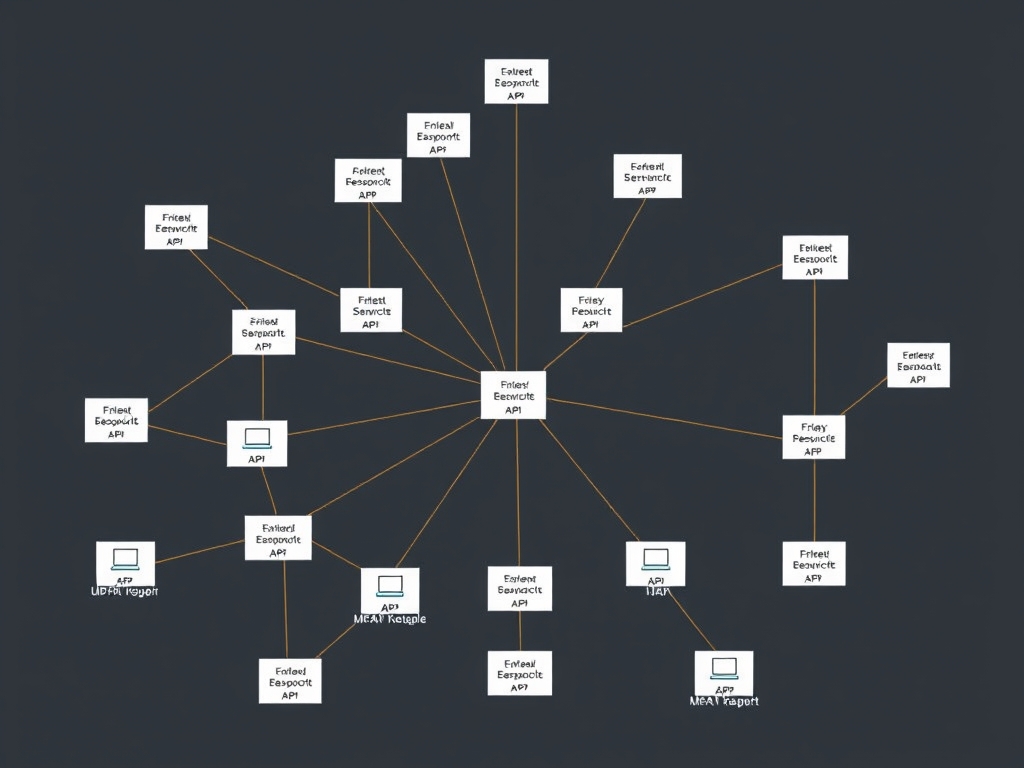
In today's dynamic digital landscape, the power of microservices architecture is undeniable. A recent report by Gartner projects a 25% increase in the adoption of microservices by 2025, highlighting the growing need for seamless and efficient API integration strategies. Ignoring a robust API Integration Strategy within a microservices environment is like building a car without an engine—it simply won't function effectively.
Foundational Context: Market & Trends
The microservices market is experiencing explosive growth. According to a study by Grand View Research, the global microservices market was valued at USD 3.19 billion in 2021 and is expected to expand at a compound annual growth rate (CAGR) of 22.4% from 2022 to 2030. This growth is fueled by the increased demand for scalable, flexible, and resilient applications.
Here's a quick comparison:
| Feature | Monolithic Architecture | Microservices Architecture |
|---|---|---|
| Scalability | Limited | High |
| Deployment | Complex | Simplified |
| Flexibility | Low | High |
| Fault Isolation | Low | High |
The trend toward microservices is driven by several factors: the need for faster development cycles, improved fault isolation, and the ability to leverage different technologies for different services. The focus is shifting toward decentralized data management, allowing for independent scalability and updates.
Core Mechanisms & Driving Factors
Successful API integration in a microservices architecture hinges on several key elements. Focusing on these pillars is essential for success:
- API Design: Creating well-defined, versioned, and documented APIs is critical.
- API Management: Implementing robust API gateways, traffic management, and security controls.
- Communication Protocols: Utilizing efficient communication methods like REST, gRPC, or GraphQL.
- Data Consistency: Ensuring data integrity across distributed services, often through techniques like eventual consistency or distributed transactions.
- Monitoring and Observability: Implementing real-time monitoring and logging to identify and resolve issues quickly.
- Security: Protecting APIs using authentication, authorization, and encryption.
The Actionable Framework
Let’s delve into an actionable framework for designing your API integration strategy.
1. Define Service Boundaries
The first step is to carefully define service boundaries. This involves identifying the specific functions or capabilities each microservice will provide. Each service should be loosely coupled and have a specific responsibility. This will ensure they function as independent units.
2. Choose the Right Communication Protocol
Selecting the appropriate communication protocol is paramount. REST (Representational State Transfer) remains popular for its simplicity and ease of use. gRPC, a high-performance framework developed by Google, is another option, especially when inter-service communication requires high throughput and low latency. GraphQL offers flexibility, allowing clients to request precisely the data they need.
3. Design API Contracts
API contracts, often defined using tools like OpenAPI (formerly Swagger), serve as blueprints for communication. They specify the endpoints, data formats, and authentication methods. These contracts are critical to ensure that each service is aligned with the required architecture.
4. Implement API Gateways
API gateways act as the entry point for all API requests. They handle tasks like authentication, authorization, rate limiting, and traffic management. Using an API gateway reduces the complexity of managing and securing your API across different services.
5. Prioritize Security
Security must be an integral part of your API Integration Strategy. Implementing secure authentication and authorization mechanisms is crucial. Consider using OAuth 2.0 or JWT (JSON Web Tokens) for authentication. Regularly audit your APIs to identify and address vulnerabilities.
6. Utilize API Management Tools
A good API management tool provides comprehensive capabilities, including API documentation, versioning, analytics, and monitoring. This can help you streamline and simplify API design.
7. Embrace Monitoring and Observability
Real-time monitoring and logging are indispensable for identifying and resolving issues. Implement monitoring tools that provide insights into API performance, error rates, and response times. Implement logs to see everything that is going on.
Analytical Deep Dive
Consider the impact of efficient API integration on application performance. According to research, companies that effectively integrate their APIs see, on average, a 15-20% improvement in application responsiveness and a 10-15% reduction in integration-related issues. Additionally, efficient API management can free up valuable development resources, allowing teams to focus on core business logic rather than integration complexities.
Strategic Alternatives & Adaptations
For Beginners: Focus on the fundamentals, such as using RESTful APIs and basic API gateway functionalities. Begin with smaller, less complex microservices.
For Intermediate Users: Explore advanced features like event-driven architectures (e.g., using message queues like Kafka) and more sophisticated API management tools.
For Experts: Consider techniques like API mesh, and service discovery to enhance scalability. Also, evaluate advanced security measures such as API firewalls.
Validated Case Studies & Real-World Application
A leading e-commerce company, for example, successfully transitioned from a monolithic architecture to a microservices architecture. By implementing a well-defined API Integration Strategy, they were able to:
- Reduce deployment times by 40%.
- Improve application scalability.
- Increase developer productivity.
This resulted in faster feature releases, enhanced customer experience, and significant cost savings.
Risk Mitigation: Common Errors
Several common pitfalls can undermine your API Integration Strategy.
- Poor API Design: APIs that are poorly designed or undocumented can lead to integration headaches.
- Solution: Create clear, well-documented APIs from the outset and use versioning to manage updates.
- Lack of Security: Neglecting security best practices can expose your applications to serious vulnerabilities.
- Solution: Implement robust authentication, authorization, and encryption mechanisms.
- Insufficient Monitoring: Not monitoring APIs can make it difficult to identify and resolve performance issues.
- Solution: Invest in comprehensive monitoring and logging tools.
- Over-complicating: Overly complex API setups can be difficult to manage.
- Solution: Start with simple, modular designs and gradually add complexity as needed.
Performance Optimization & Best Practices
To maximize the effectiveness of your API Integration Strategy, follow these steps:
- Prioritize API versioning to enable seamless upgrades.
- Optimize for performance: Minimize data transfer sizes and optimize endpoint responses.
- Implement comprehensive API documentation: This will improve developer collaboration.
- Automate your testing: This will prevent unexpected problems.
- Focus on API monitoring: This ensures that issues are quickly identified and resolved.
Scalability & Longevity Strategy
For sustained success, prioritize scalability, automation, and regular updates.
- Automation: Automate API deployment, testing, and monitoring to reduce manual effort.
- Regular Updates: Keep your API management tools and architecture current.
- Scalability: Design your microservices for horizontal scaling.
Key Takeaways: Building a Robust API Integration Strategy
- Define clear service boundaries.
- Choose the right communication protocols.
- Design effective API contracts.
- Prioritize API security.
- Implement API monitoring.
Frequently Asked Questions (FAQ)
Q: What is an API gateway, and why is it important in a microservices architecture?
A: An API gateway is the single point of entry for all API requests. It handles tasks like authentication, authorization, rate limiting, and traffic management, simplifying the management and security of your APIs.
Q: What are some common communication protocols used in microservices?
A: REST, gRPC, and GraphQL are common choices. REST is widely used for its simplicity; gRPC is suitable for high-performance inter-service communication, and GraphQL offers flexibility in data requests.
Q: How can I ensure data consistency across multiple microservices?
A: Data consistency can be achieved through techniques such as eventual consistency (using message queues) or distributed transactions, depending on the requirements of your application.
Q: What are the benefits of using a microservices architecture?
A: Microservices architecture offers increased scalability, faster development cycles, improved fault isolation, and the ability to use different technologies for different services, making your application more efficient and resilient.